Charts
Three views of per-acre productivity: landmark comparisons, the lot-size curve,
and municipal totals. All data from the 2025 Chemung County assessment roll
joined to county parcel shapefile acreage.
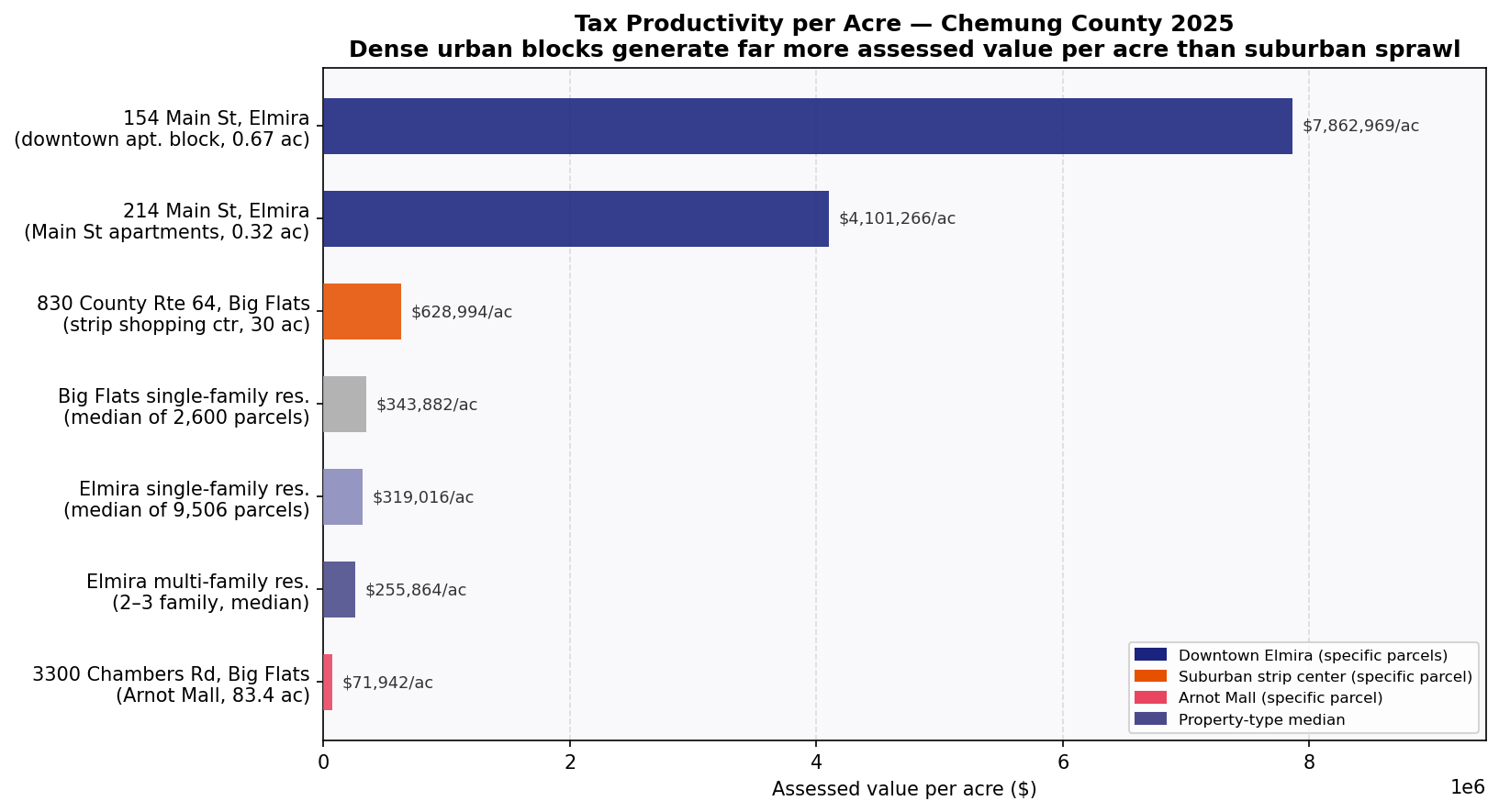
The Arnot Mall sits on 83 acres and produces $72,000 in assessed value per acre. A single apartment building on Main Street in Elmira produces $7.9 million per acre. Land is finite. How we use it is a fiscal choice.
The per-acre lens matters because land is the one resource a municipality cannot expand. Infrastructure cost — roads, water, sewer, storm drains, emergency response travel time — scales with area served, not just assessment total. A development pattern that spreads the same tax base across ten times as much land produces structurally higher infrastructure costs per dollar of revenue collected.
This is not an argument against suburban development. It is an argument for pricing it honestly — and for not systematically undervaluing the fiscal productivity of the denser, older urban fabric that already exists.
The Arnot Mall at $6 million assessed value looks like a significant taxpayer in absolute terms. But it occupies 83 acres — enough land to hold roughly 450 typical Elmira single-family lots. Those 450 lots would, at the city's median single-family assessment of $55,000 per property, produce over $24 million in assessed value. The mall produces $6 million. The land is doing far less fiscal work than an equivalent footprint of urban fabric would.
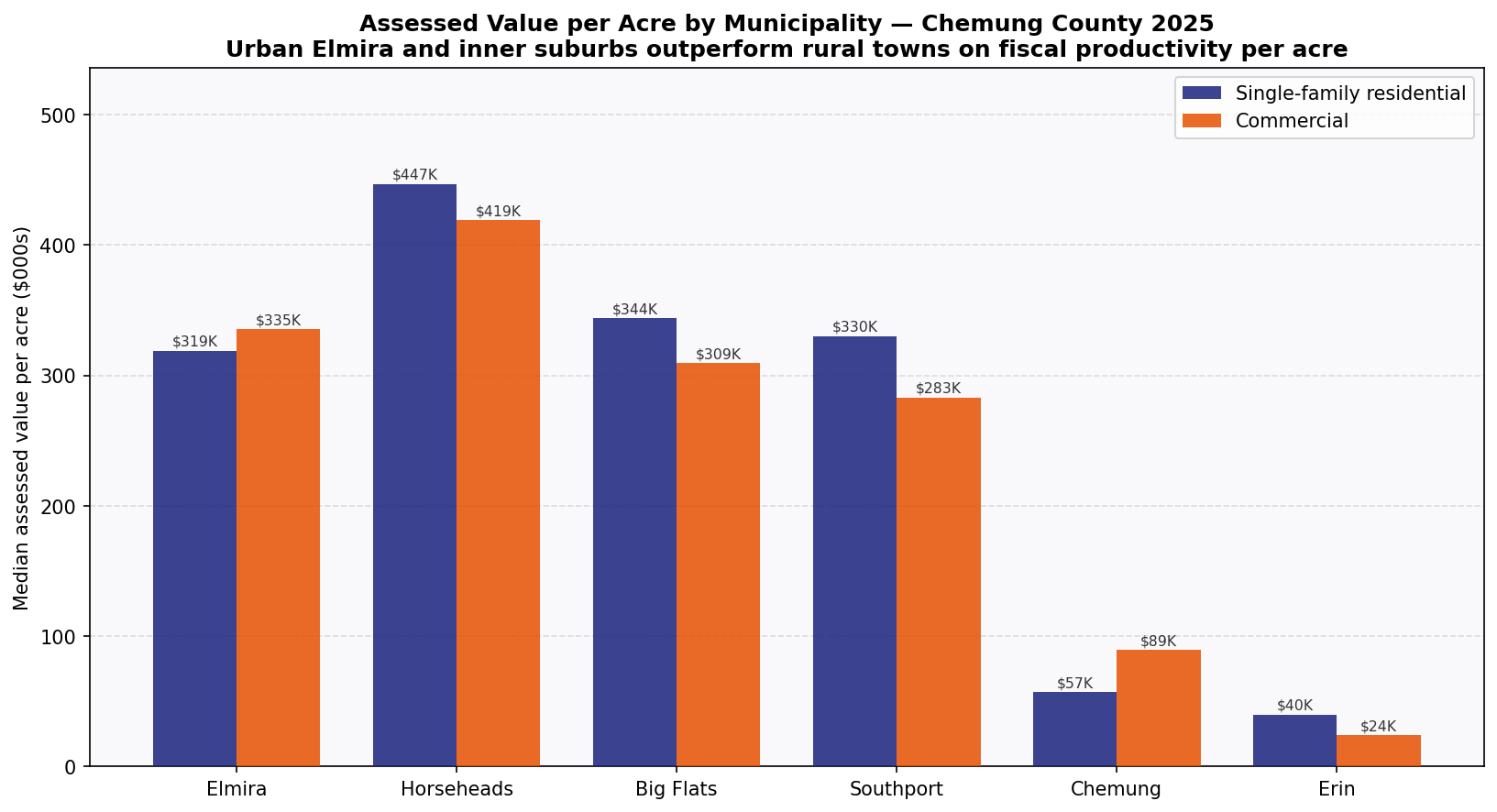
Big Flats and Horseheads — the county's primary commercial growth zones — produce $288K and $254K per acre across their commercial base, respectively. Elmira's commercial parcels produce $310K per acre. The city's commercial strip is actually more fiscally productive per acre than the Route 17 corridor — even with stagnant assessments and decades without reassessment.
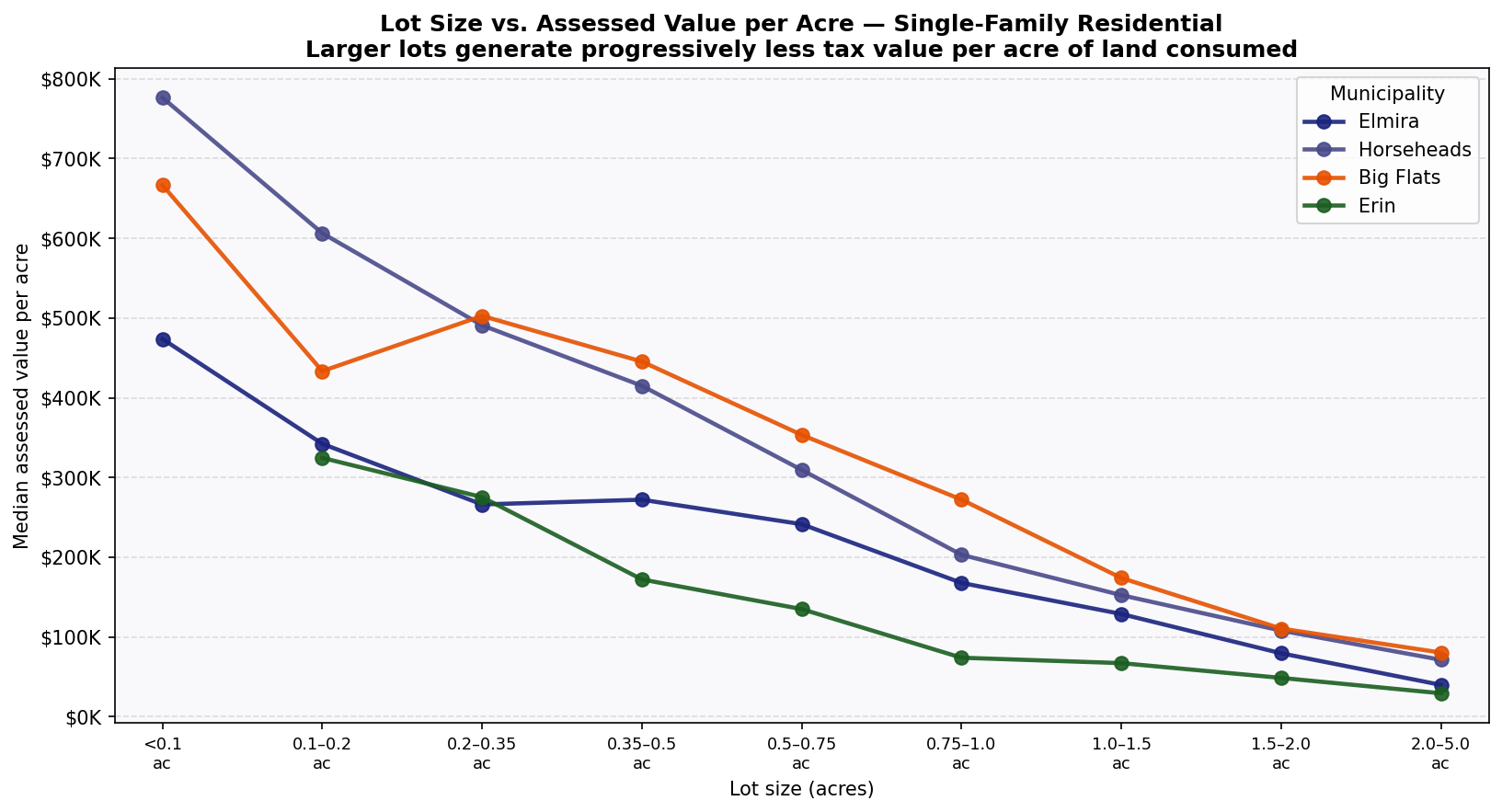
A single-family home on a city lot under 0.1 acres in Elmira produces a median of $474,000 in assessed value per acre. The same type of property on a 2–5 acre rural lot produces only $40,000 per acre — a 12:1 ratio. The pattern holds across municipalities: Horseheads single-family homes on small lots produce $776K/acre; on large lots the same town's homes drop below $72K/acre.
This is structural, not a quirk of individual properties. A home worth $100,000 on a quarter-acre lot produces $400,000/acre. The same home on a two-acre lot produces $50,000/acre. The house hasn't changed. The land consumption has — and so has the infrastructure burden.
Infrastructure cost doesn't scale with assessment total — it scales with the area served. A water main running past a two-acre lot costs roughly the same per foot as one running past a quarter-acre lot. Roads don't know whether the house they front is assessed at $50,000 or $200,000. The larger the lot, the worse the ratio of infrastructure cost to tax revenue generated.
Between 2021 and 2025, Chemung County's total taxable assessed value grew by approximately $785 million. Nearly all of that growth happened in the suburban ring — in municipalities where lot sizes are larger, commercial footprints are bigger, and AV/acre is structurally lower. The county is, in fiscal terms, getting more expensive to service at the same time it is growing.
The City of Elmira, by contrast, has a higher commercial AV/acre than its suburban competitors — but its total assessed value has been essentially flat for years, held down by frozen assessments, a large exempt sector, and disinvestment from properties that could be producing more. The city's per-acre productivity advantage is not reflected in revenue because the underlying assessments are themselves depressed.
A citywide reassessment wouldn't change the per-acre fundamentals — downtown Elmira would still beat Big Flats strip retail on productivity per acre. But it would close the gap between what properties are worth and what they're assessed at, allowing the city to capture the revenue its land use pattern is actually capable of generating.
For the broader context on where the county's assessment growth has happened — and hasn't — see the Trends page. For the argument that reassessment is both possible and necessary to capture the city's productivity advantage, see Elmira: The Frozen Roll.